

Affiliate marketing is one of the most popular ways to earn money online. It allows individuals, bloggers, content creators, and website owners to earn a commission by promoting products or services from other companies.
The basic concept is simple: you recommend a product using a special affiliate link, someone clicks your link and makes a qualifying purchase or completes an eligible action, and you receive a commission.
You do not need to create your own product, manage inventory, or handle shipping. However, successful affiliate marketing requires useful content, the right audience, trust, and a consistent strategy.
In this beginner-friendly guide, you will learn the basics of affiliate marketing, how it works, how to choose affiliate programs, how to promote affiliate products, and what mistakes beginners should avoid.
What Is Affiliate Marketing Basics ?
Affiliate marketing is a performance-based marketing model where a business rewards an affiliate for generating a sale, lead, or other qualifying action.
There are usually three main parties involved:
- Merchant or Advertiser – The company that sells the product or service.
- Affiliate – The person or website that promotes the product.
- Customer – The person who clicks the affiliate link and purchases or signs up for the product.
For example, imagine you run a website about digital marketing. You write an article about the best SEO tools and recommend a particular software product.
You include your unique affiliate link in the article. If a reader clicks the link and purchases the software, you may receive a commission according to the affiliate program’s terms.
Affiliate marketing can be used with websites, blogs, YouTube channels, social media, newsletters, and other content platforms.
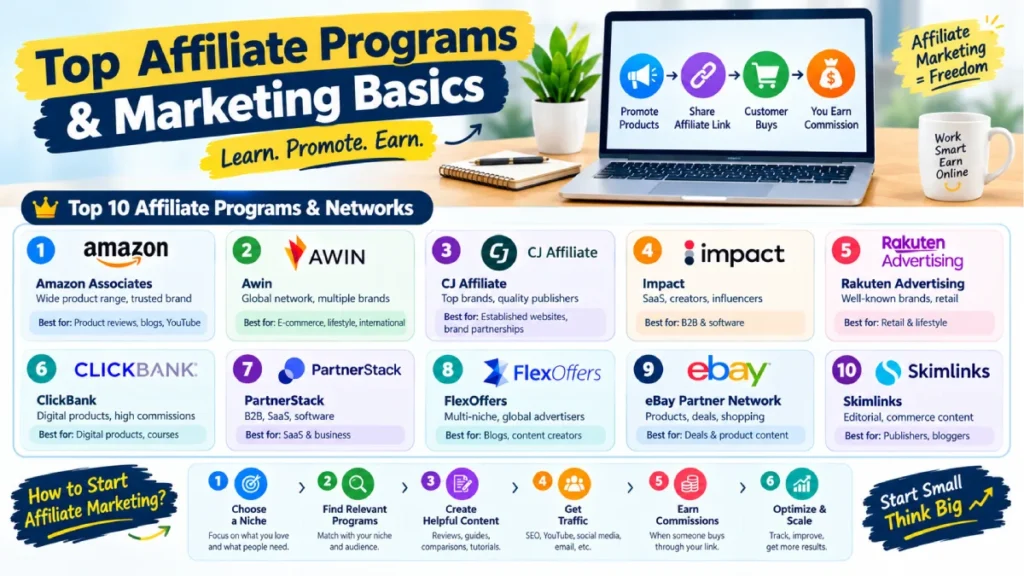
How Does Affiliate Marketing Work?
The affiliate marketing process generally follows a simple sequence.
Step 1: Join an Affiliate Program
First, you join an affiliate program offered by a company or an affiliate network.
Step 2: Get Your Affiliate Link
After approval, you receive a unique tracking link. This link identifies the traffic or customers you refer.
Step 3: Create Useful Content
You create content around the product, service, or problem your audience is interested in.
For example, you might create:
- Product reviews
- Tutorials
- Comparison articles
- How-to guides
- Listicles
- Case studies
- YouTube videos
- Social media posts
Step 4: Promote Your Affiliate Link
You place your affiliate link naturally within your content where it provides value to the reader.
Step 5: Earn a Commission
If a visitor completes the required action through your affiliate link, you may receive a commission.
Why Is Affiliate Marketing Popular?
Affiliate marketing has become popular because it offers a relatively accessible way to start an online business.
1. You Don’t Need Your Own Product
One of the biggest advantages is that you can promote products created by other companies.
You do not have to develop software, manufacture physical products, or create an online course before getting started.
2. Low Startup Cost
A basic affiliate marketing business can be started with relatively little investment.
For example, you may start with:
- A website
- A domain name
- Web hosting
- Content creation tools
- Basic SEO tools
You can also promote affiliate products through platforms where you already have an audience.
3. Flexible Working Model
Affiliate marketing can be done from almost anywhere with an internet connection. You can create content according to your own schedule.
4. Multiple Monetization Opportunities
A single website can potentially promote products from multiple affiliate programs, provided the programs and promotional methods allow it.
For example, a digital marketing website could promote SEO software, email marketing platforms, website hosting, design tools, and productivity software.
5. Content Can Continue to Bring Traffic
A useful article can potentially attract search engine traffic for a long time.
However, this is not guaranteed. Search rankings, competition, product availability, and user interests can change, so content should be reviewed and updated regularly.
Types of Affiliate Marketing Basics
Affiliate marketing is not limited to one type of product or promotion method.
Product Affiliate Marketing
This involves promoting physical or digital products.
Examples include:
- Electronics
- Books
- Software
- Online courses
- Website themes
- Digital tools
SaaS Affiliate Marketing
SaaS stands for Software as a Service. Many software companies offer affiliate programs.
For example, marketers may promote:
- SEO platforms
- Email marketing tools
- Project management software
- Graphic design platforms
- CRM software
Service Affiliate Marketing
Some businesses offer commissions for referring customers to services.
These may include web hosting, marketing services, educational platforms, or other online services.
Lead Generation Affiliate Marketing
Some affiliate programs pay affiliates when a referred visitor completes a qualifying action, such as submitting a form, requesting information, or signing up for a service.
How to Choose the Right Affiliate Program
Choosing the right affiliate program is one of the most important decisions for beginners.
Do not select a program simply because it offers a high commission.
Instead, consider several factors.
Relevance
The product should be relevant to your website and audience.
If your website focuses on SEO, recommending an unrelated product may confuse your readers and reduce trust.
Product Quality
Only promote products or services that you believe provide genuine value.
Your reputation is more important than earning a quick commission.
Commission Structure
Check how commissions are calculated.
Some programs offer a percentage of the purchase price, while others offer fixed commissions.
Cookie or Tracking Period
Some affiliate programs track referrals for a specific period after someone clicks your affiliate link.
The tracking period varies between programs, so always read the program’s current terms.
Payment Terms
Check the minimum payout, payment methods, payment schedule, and any other requirements before joining.
Affiliate Policies
Always read the affiliate program’s rules. Some companies have restrictions regarding paid advertising, email marketing, trademarks, coupons, or specific promotional methods.
How to Start Affiliate Marketing Step by Step
If you are completely new to affiliate marketing, follow these basic steps.
Step 1: Choose a Niche
Start with a topic you understand or are willing to learn about.
Examples include:
- Digital marketing
- SEO
- AI tools
- Web hosting
- Productivity
- Personal finance
- Education
- Software
- Technology
A focused niche makes it easier to create relevant content and attract a specific audience.
Step 2: Build a Platform
You need somewhere to publish your content.
A website or blog is one popular option. You can also use other content platforms depending on the affiliate program’s rules.
For a long-term strategy, having your own website gives you more control over your content and audience experience.
Step 3: Research Affiliate Programs
Look for reputable companies that offer affiliate programs related to your niche.
You can find programs directly on company websites or through affiliate networks.
Before joining, carefully review the terms and conditions.
Step 4: Create Helpful Content
Avoid creating content that exists only to place affiliate links.
Instead, focus on solving problems.
For example:
Weak approach:
“Buy this SEO tool because it is great.”
Better approach:
“Best SEO Tools for Beginners: Features, Pricing, Pros, Cons, and Who Should Use Them.”

Step 5: Add Affiliate Links Naturally
Affiliate links should be placed where they are useful to readers.
For example, after explaining the features of a tool, you could provide a relevant call-to-action.
Do not add dozens of affiliate links to every paragraph.
The goal should be to help the reader first and monetize the content second.
Step 6: Disclose Affiliate Relationships
Transparency is an important part of affiliate marketing.
If you may earn a commission from a recommendation, clearly disclose that relationship to your audience.
A simple disclosure can explain that some links are affiliate links and that you may receive a commission if the reader makes a qualifying purchase, without additional cost to them where applicable.
The exact disclosure requirements can vary by country, platform, and situation, so publishers should check the rules that apply to them.
SEO Strategies for Affiliate Marketing Basics
Search engine optimization can help affiliate content reach people who are actively searching for information.
Focus on Search Intent
Before writing an article, understand what the searcher actually wants.
For example:
- “What is SEO?” indicates informational intent.
- “Best SEO tools” indicates comparison or commercial intent.
- “SEO tool pricing” indicates a more specific commercial query.
Create content that matches the intent behind the search.
Use Relevant Keywords
Use your primary keyword naturally in:
- Title
- Introduction
- Headings
- URL
- Meta description
- Image alt text where appropriate
Avoid keyword stuffing.
Create Original and Helpful Content
Your article should offer something useful rather than simply rewriting information available elsewhere.
Add your own explanations, comparisons, examples, screenshots, tables, experiences where appropriate, and practical tips.
Keep Content Updated
Affiliate products can change.
Prices, features, commission structures, screenshots, and availability may become outdated.
Review important affiliate articles periodically and update them when necessary.

Common Affiliate Marketing Mistakes Beginners Should Avoid
Affiliate marketing may look easy, but many beginners make avoidable mistakes.
Promoting Too Many Products
Promoting every product you find can make your website look like a collection of advertisements.
Choose products that genuinely fit your audience.
Focusing Only on Commission
A product with a high commission is not automatically the best product to promote.
Consider quality, relevance, customer experience, and your audience’s needs.
Creating Thin Content
Short articles with little useful information are unlikely to provide much value.
Instead, create comprehensive content that answers the reader’s questions.
Ignoring SEO
Good content still needs to be discoverable.
Learn basic keyword research, on-page SEO, internal linking, technical SEO, and content optimization.
Using Misleading Claims
Never promise guaranteed income or make unsupported claims about a product.
Be honest about advantages and limitations.
Forgetting Affiliate Disclosure
Always be transparent about affiliate relationships.
This can help maintain trust with your readers and may be required by applicable regulations or platform policies.
How Much Money Can You Make With Affiliate Marketing?
There is no fixed amount that everyone earns from affiliate marketing.
Your results can depend on factors such as:
- Website traffic
- Audience quality
- Content quality
- Conversion rate
- Product price
- Commission rate
- Affiliate program terms
- Search rankings
- Promotion strategy
Some beginners may earn little or nothing at first because building traffic and trust takes time.
As your website grows, you may have more opportunities to generate affiliate revenue.
However, affiliate marketing should be treated as a long-term business strategy rather than a guaranteed way to make quick money.
Affiliate Marketing Best Practices
For better long-term results, keep these principles in mind:
- Put the audience first.
- Promote relevant products.
- Create original and useful content.
- Be honest about products and services.
- Disclose affiliate relationships clearly.
- Optimize content for search intent.
- Track your performance.
- Update old content regularly.
- Follow each affiliate program’s rules.
- Focus on building trust instead of chasing quick commissions.
Final Thoughts
Affiliate marketing can be a useful monetization strategy for bloggers, website owners, and content creators.
The basic process is straightforward: choose a niche, build an audience, join relevant affiliate programs, create helpful content, recommend useful products, and earn commissions from qualifying referrals.
However, successful affiliate marketing is not simply about placing affiliate links on a website. The strongest approach is to create content that genuinely helps people solve problems and make better purchasing decisions.
If you are a beginner, start small. Choose one niche, learn about your audience, create high-quality content, and gradually expand your affiliate strategy.
With consistency, transparency, SEO, and a focus on providing real value, affiliate marketing can become an important part of a broader online business.


Pingback: Amazon Affiliate Marketing: A Complete Beginner’s Guide
Pingback: Learn Digital Marketing and Earn Money Online